
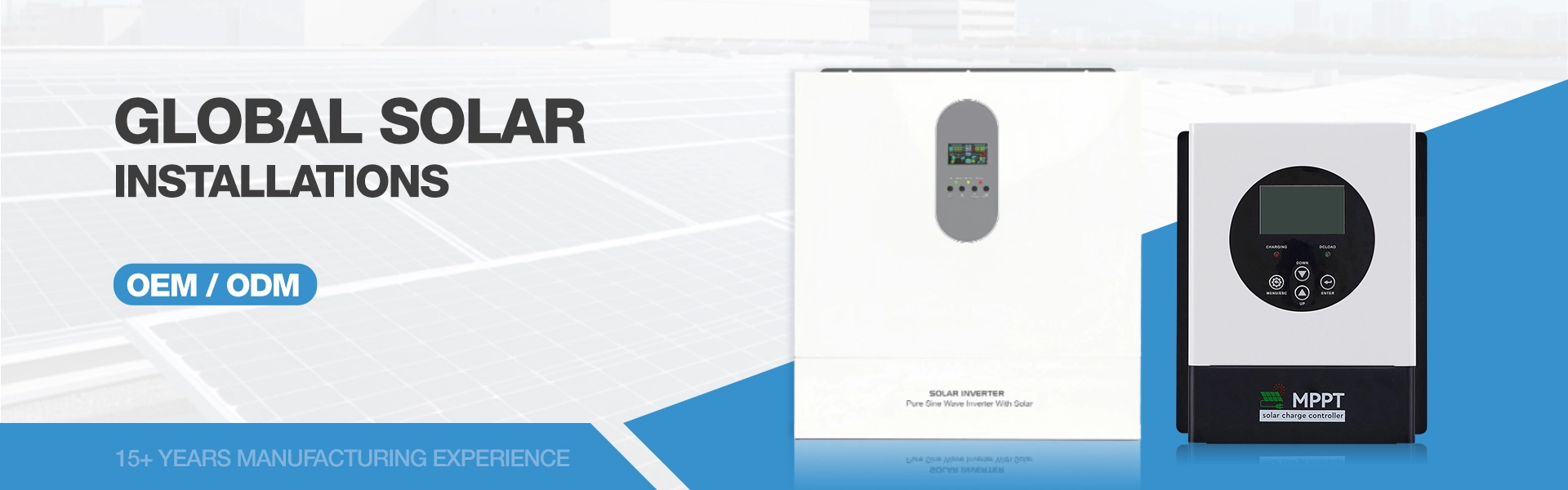
Unlocking Solar System Efficiency: The Core Role and Technology Behind MPPT Solar Charge Controllers
Introduction: Powering the Future with Smart Solar Technology
As the global demand for renewable energy continues to grow, solar power systems are becoming increasingly popular for residential, commercial, and industrial applications. However, the efficiency of any solar system heavily depends on one critical component — the solar charge controller. Among various types, the MPPT (Maximum Power Point Tracking) solar charge controller stands out as the most advanced and efficient technology for maximizing solar energy utilization.
This article dives deep into the core principles, working mechanisms, and advantages of MPPT technology, helping installers, distributors, and solar professionals understand why MPPT controllers are the key to a stable and efficient solar system.
What Is an MPPT Solar Charge Controller?
An MPPT solar charge controller is a smart device that optimizes the power flow between solar panels and batteries. Its main purpose is to track the maximum power point (MPP) — the point at which solar panels produce the highest power output — and continuously adjust the charging parameters to ensure the system operates at maximum efficiency.
Unlike basic controllers, MPPT models use advanced electronic conversion techniques to intelligently transform excess voltage from solar panels into additional charging current. This makes them especially suitable for systems using high-voltage solar arrays and lithium battery setups.
How MPPT Technology Works
Solar panels do not always operate at their ideal voltage due to changes in sunlight intensity, temperature, and shading. The MPPT controller constantly monitors these conditions and adjusts the electrical operating point to extract the maximum possible energy from the solar array.
In simple terms, the MPPT controller performs the following tasks:
-
Continuously measures the output voltage and current of the solar array.
-
Calculates the real-time power output (P = V × I).
-
Uses a tracking algorithm to find the voltage where power is highest.
-
Adjusts the converter’s duty cycle to maintain operation at that optimal point.
Through this real-time adjustment, MPPT controllers can boost charging efficiency by 20%–30% compared to traditional PWM controllers, especially under variable weather conditions.
Main MPPT Tracking Algorithms
Different manufacturers adopt various algorithms to achieve accurate tracking of the maximum power point. The most common ones include:
-
Perturb and Observe (P&O) – The most widely used method. It slightly adjusts voltage and observes changes in power output to locate the optimal point.
-
Incremental Conductance (IncCond) – More precise under rapidly changing sunlight, it calculates the slope of the power curve to track the MPP.
-
Constant Voltage Tracking – Simpler but less efficient, mainly used in small systems.
-
Fuzzy Logic or Neural Network Algorithms – Advanced AI-based tracking methods for high-end systems, offering ultra-fast response and high accuracy.
The choice of algorithm directly impacts energy harvest efficiency and system stability.
MPPT vs. PWM: Why MPPT Is the Smarter Choice
| Feature | PWM Controller | MPPT Controller |
|---|---|---|
| Charging Efficiency | 70–80% | 95–98% |
| Conversion Type | Direct connection (no voltage conversion) | DC-DC conversion |
| System Voltage Adaptability | Limited | Wide range (12V–96V automatic recognition) |
| Performance in Cloudy/Cold Weather | Poor | Excellent |
| Cost | Lower | Slightly higher, but better long-term ROI |
MPPT controllers are ideal for large and professional systems, including off-grid homes, RVs, industrial setups, and power stations, where efficiency and reliability are key factors.
Key Advantages of MPPT Solar Charge Controllers
-
Higher Charging Efficiency (up to 98%)
Converts excess panel voltage into additional battery current, maximizing energy harvest. -
Automatic Voltage Recognition
Intelligent detection for 12V, 24V, 36V, 48V, 72V, or 96V systems — flexible and easy to install. -
Lithium Battery Activation
Supports smart activation and full protection for LiFePO₄ and other lithium batteries. -
Smart Communication (RS485 Interface)
Enables real-time monitoring, parameter adjustment, and remote control. -
LCD Display for Intuitive Operation
Displays detailed data such as PV voltage, charging current, and battery status. -
Robust Protection Features
Includes overcharge, over-discharge, reverse polarity, and over-temperature protection.
Application Scenarios
MPPT solar charge controllers are widely used in:
-
Residential solar systems (off-grid homes, apartments, and rural housing)
-
Recreational vehicles (RVs) and marine systems
-
Industrial and telecommunication equipment
-
Solar farms and mini power stations
Their adaptability and high efficiency make them suitable for various environments — from small home setups to large-scale commercial installations.
Why Choose Yingke MPPT Solar Charge Controllers?
With 13 years of manufacturing experience, Yingke is a professional supplier of solar products, including MPPT solar charge controllers, hybrid inverters, UPS systems, batteries, and solar panels.
Our MPPT controllers are designed for high efficiency, reliability, and intelligent control, featuring:
-
Automatic voltage recognition (12V–96V)
-
Up to 98% conversion efficiency
-
RS485 communication interface
-
LCD display for easy monitoring
-
CE, RoHS, and FCC certifications
We provide OEM & ODM services, support bulk wholesale orders, and welcome distributors and installers to join our global partner network.
Conclusion: Empowering Solar Energy with Smarter Control
In modern solar systems, the MPPT solar charge controller serves as the core energy optimizer, ensuring every watt generated by solar panels is effectively stored and utilized.
Whether for home, RV, or industrial applications, choosing a high-quality MPPT controller means achieving better efficiency, stability, and long-term value.
If you are looking for a reliable solar controller factory, Yingke is your trusted partner.
👉 Contact us today for competitive quotations, OEM cooperation, and distributor opportunities.